Popular Examples
- Resumes
- Cover Letters
- CVs
- Idioms
- Excel Templates
- Business Examples
- Business Letters
- Love Letters
- Personal Letters
- Science
- Math Examples
More Society
- Example of Subculture
- Example of Clairvoyance
- Example of Coats of Arms
- Example of Different Types of Prayers, Examples Prayer Methods, Examples Prayers
- Example of Ethos, Logos, and Pathos
- Example of Famous People Personalities
- Example of Genocide
- Example of Groupthink
- Example of Guest List
- Example of Hegemony
- Example of Human Rights
- Example of Humanism
- Example of Humanistic Perspective
- Example of Humility
- Example of Idealism
- Example of Ideology
- Example of Imperialism
- Example of IQ questions
- Example of Jealousy
- Example of Judicial Powers
- Example of Karma
- Example of Kingdom
- Example of Lust
- Example of Luxury Goods
Example of Public Goods
Public goods theory is based on some of the more obscure logic of political economics, based on the concept that a 'public good' is an exception to the 'free' market economy. This theory holds that a public good is 'consumed for free' by the entire society, and cites law enforcement, defense, and fire departments as common cases of public goods. It also states that these goods are 'non-exclusive', i.e. available to all. The concept has few if any practical applications in the real world, but is used as a basis for economic rationales. |
Examples of Public Goods:
| Democratic institutions Law courts Education Welfare organizations https://en.wikipedia.org/wiki/Public_good https://www.auburn.edu/~johnspm/gloss/public_goods |
Image Example of Public Goods:
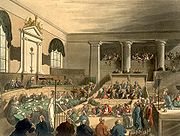 A trial at the old bailey in london as drawn by thomas rowlandson and augustus pugin for ackermann's microcosm of london (1808-11). |
